Slides / 2 of 9
Talk slides
Mobile devices with a dedicated cryptographic processor
Vyacheslav Chikin · ACE NPP, ACE Lab
Summary Transcript PDF, 2.2 MB Watch from 00:18:24
An English deck and the text under the slides These slides are an English translation of the Russian deck shown in the recording; the Russian original is on the RU version of this page. Under each slide its text is set out — for word search and for machine reading. It is recognised automatically from the same image shown above: small text inside screenshots is not always recognised, so check anything doubtful against the slide itself.
Page 1 00:18:24 Slide text
≤·ACELab® l
Mobile Devices with a Dedicated
Cryptographic Processor
2026
Page 2 00:18:55 Slide text
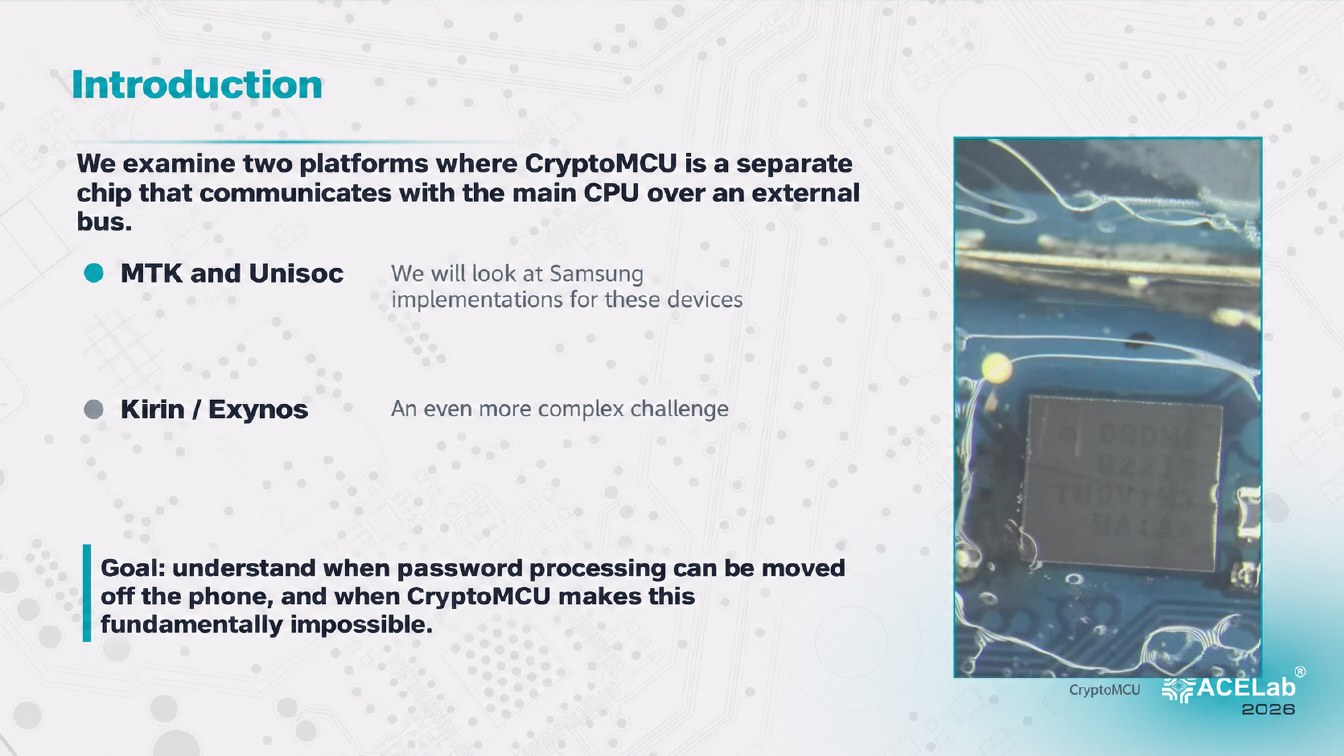
Introduction
We examine two platforms where CryptoMCU is a separate chip that communicates with the main CPU over an external bus.
• MTK and Unisoc
We will look at Samsung implementations for these devices
• Kirin / Exynos
An even more complex challenge
Goal: understand when password processing can be moved off the phone, and when CryptoMCU makes this fundamentally impossible.
CryptoMCU
2026
Page 3 00:19:33 Slide text
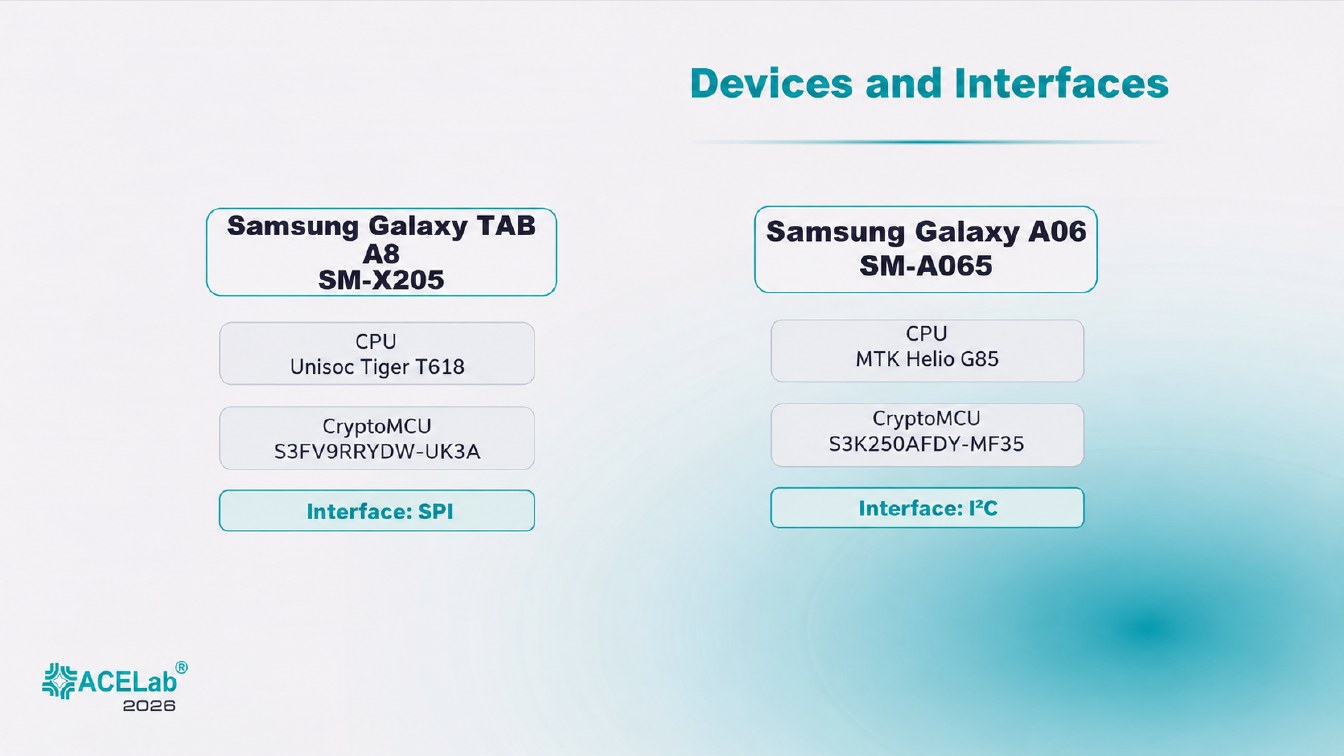
Devices and Interfaces
Samsung Galaxy TAB
A8
SM-X205
Samsung Galaxy A06
SM-A065
CPU
Unisoc Tiger T618
CPU
MK Helio G85
CryptoMCU
S3FV9RRYDW-UK3A
CryptoMCU
S3K250AFDY-MF35
Interface: SPI
Interface: °C
*YACELab®
2026
Page 4 00:20:03 Slide text
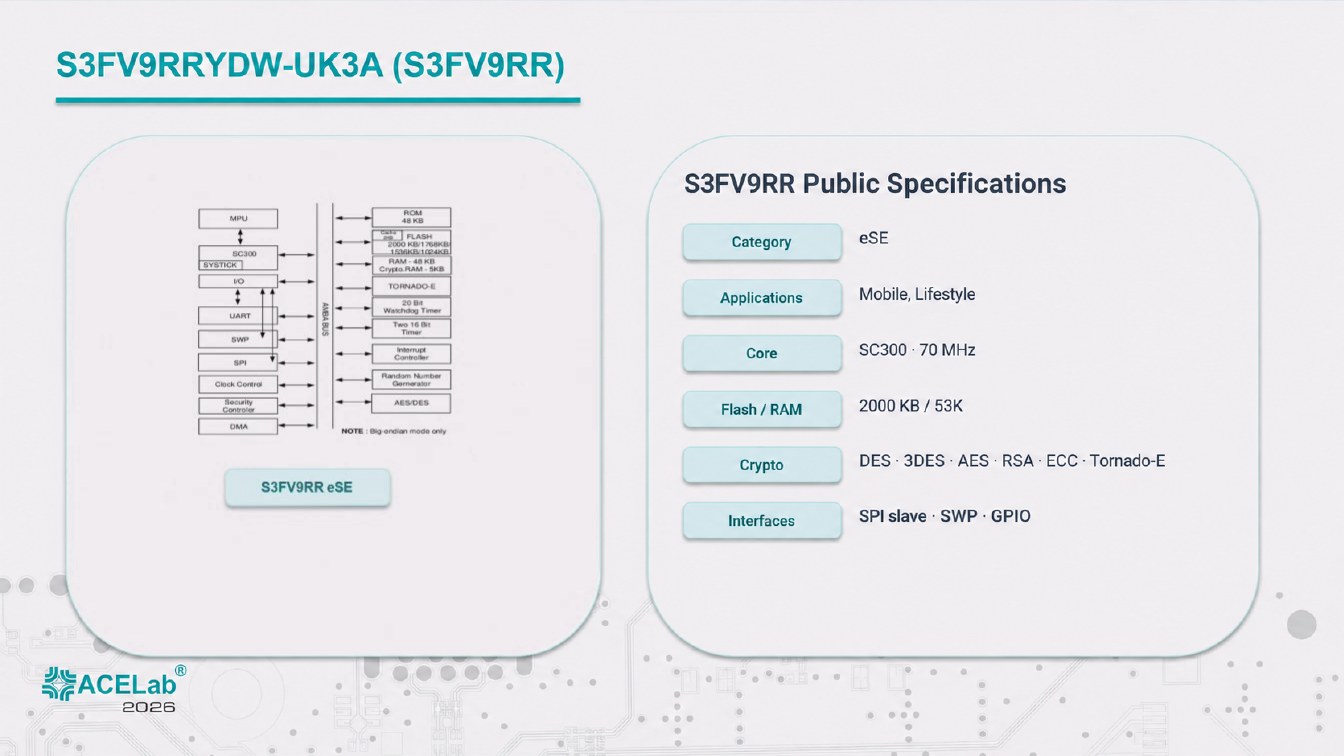
S3FV9RRYDW-UK3A (S3FV9RR)
S3FV9RR Public Specifications
MPU
SYSTICKE
UART
SPI
Clock Control
Security Controter
OMA
1534KB/1024KB)
Crypto RAM - SKB
TORNADO-E
Waschdog Timer Two 16 81
Intorrupt
AES/DES
NoTore mood cry
Category
Applications
Core
Flash / RAM
eSE
Mobile, Lifestyle
SC300 • 70 MHz
2000 KB / 53K
S3FV9RR eSE
Crypto
DES • 3DES • AES • RSA • ECC • Tornado-E
Interfaces
SPI slave • SWP • GPIO
"ACELab®
2026
Page 5 00:20:39 Slide text
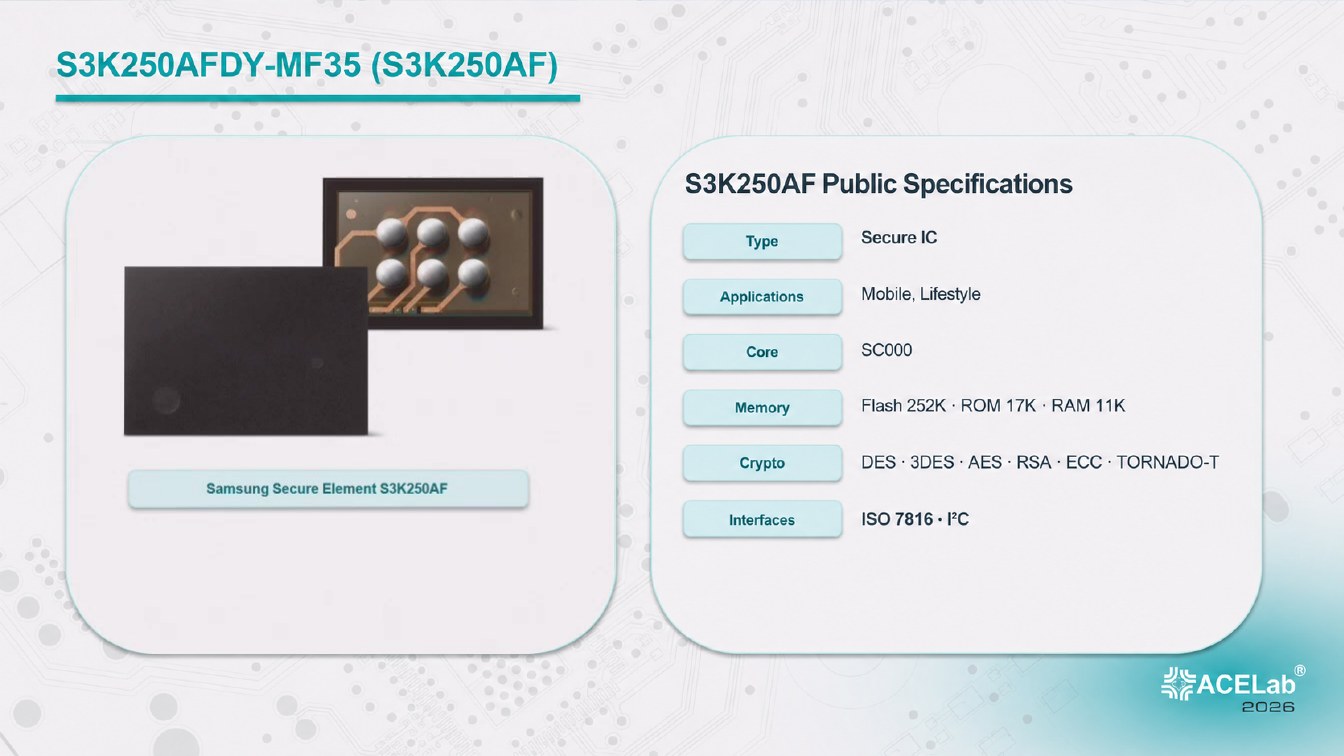
S3K250AFDY-MF35 (S3K250AF)
S3K250AF Public Specifications
Type
Secure IC
Applications
Mobile, Lifestyle
Core
SC000
Memory
Flash 252K • ROM 17K • RAM 11K
Samsung Secure Element S3K250AF
Crypto
DES • 3DES • AES • RSA • ECC • TORNADO-T
Interfaces
ISO 7816 • PC
"FACELab®
2026
Page 6 00:20:56 Slide text
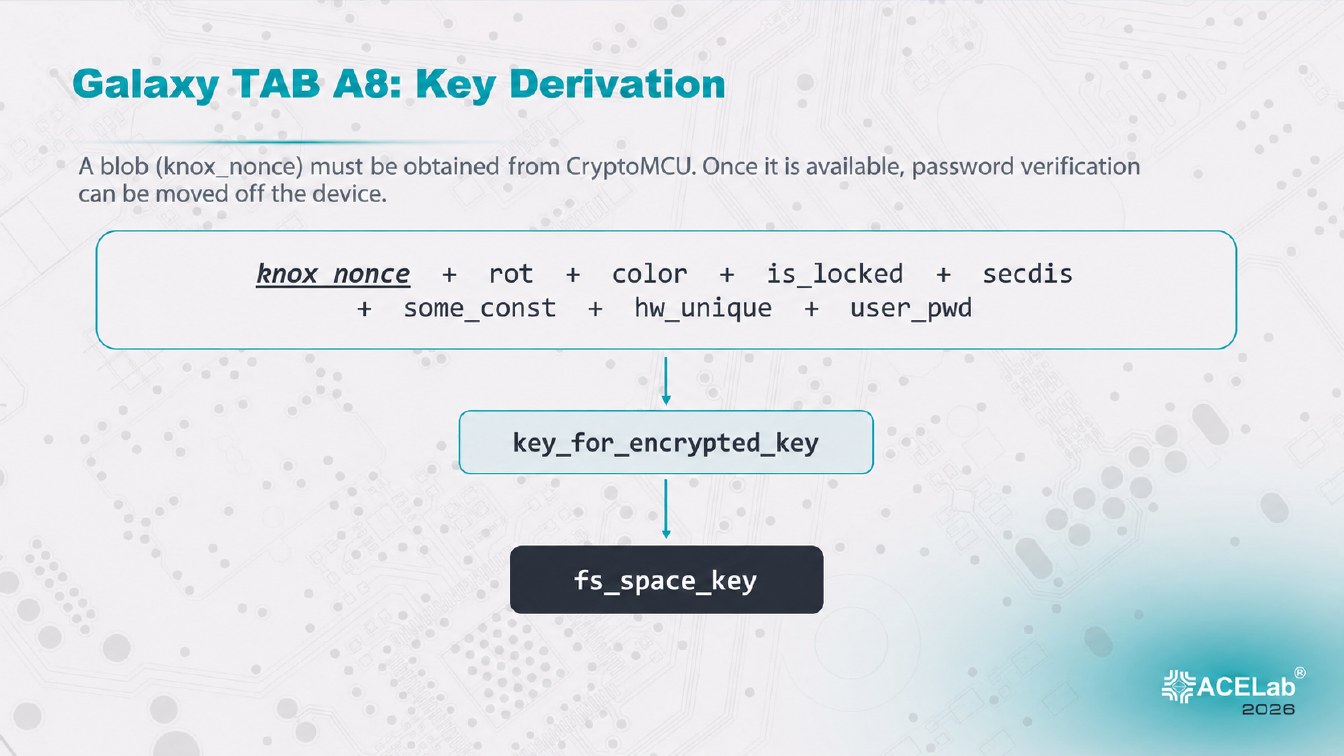
Galaxy TAB A8: Key Derivation
A blob (knox_nonce) must be obtained from CryptoMCU. Once it is available, password verification can be moved off the device.
knox nonce + rot + color + is_locked + secdis
+ some_const + hw_unique + user_pwa
key_for_encrypted_key
fs_space_key
" ACELab®
2026
Page 7 00:23:05 Slide text
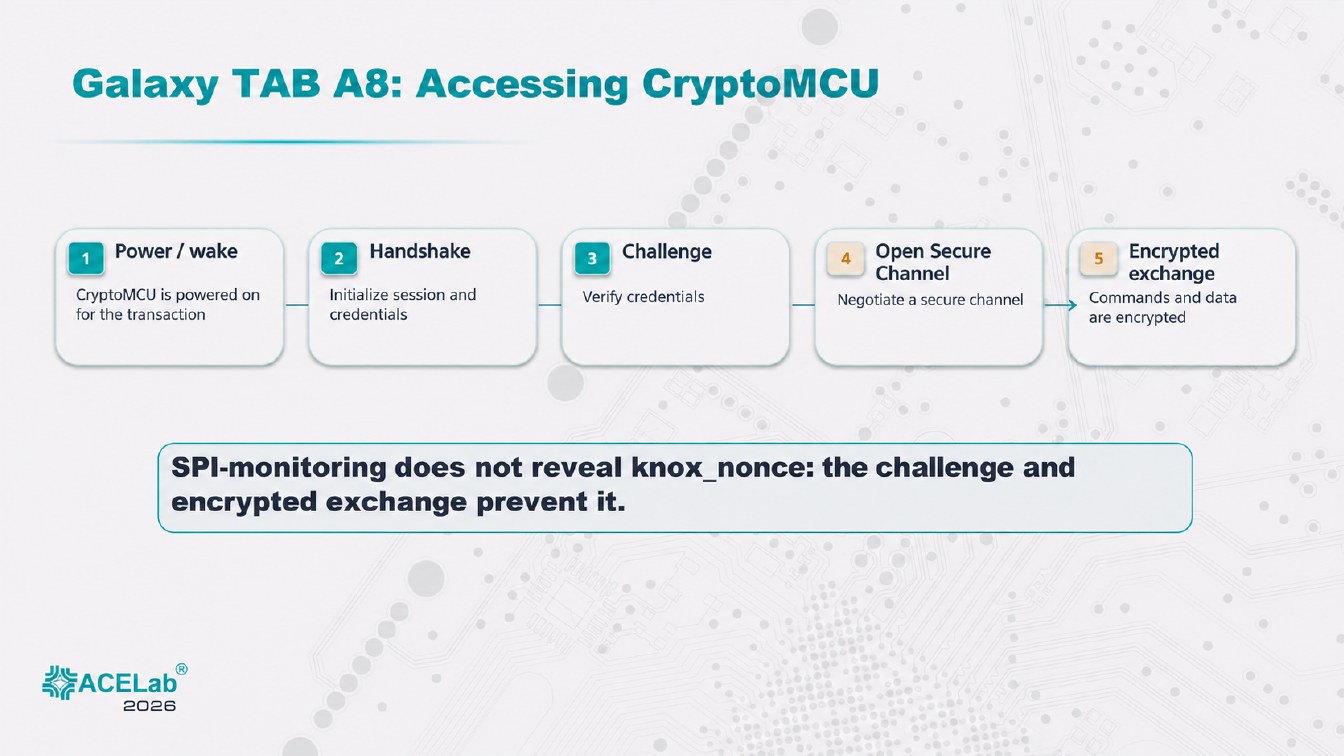
Galaxy TAB A8: Accessing CryptoMCU
1 Power / wake
CryptoMCU is powered on
for the transaction
Handshake
2
Initialize session and credentials
Challenge
3
Verify credentials
Open Secure Channel
Negotiate a secure channel
Encrypted exchange
Commands and data
are encrypted
SPI-monitoring does not reveal knox_nonce: the challenge and encrypted exchange prevent it.
*ACELab®
2026
Page 8 00:24:42 Slide text
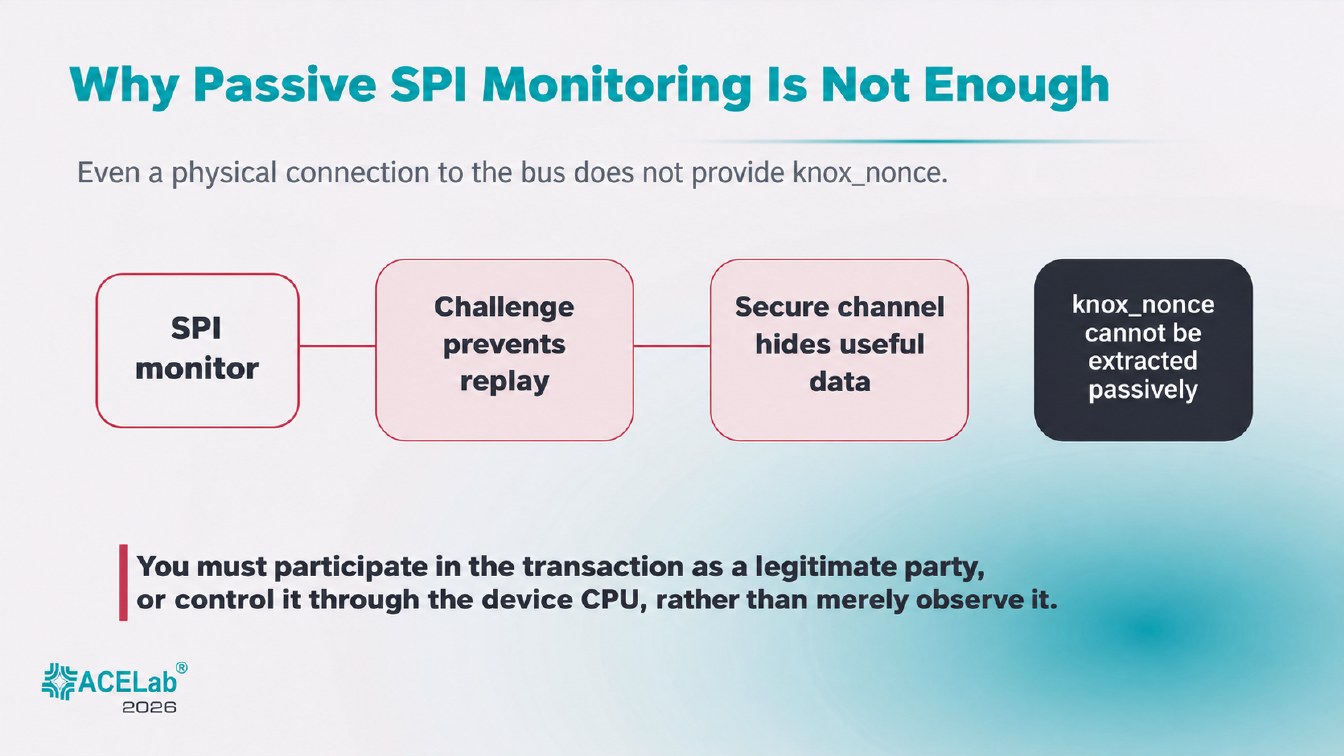
Why Passive SPI Monitoring Is Not Enough
Even a physical connection to the bus does not provide knox_nonce.
SPI
monitor
Challenge
prevents
replay
Secure channel hides useful
data
knox_nonce cannot be extracted passively
You must participate in the transaction as a legitimate party, or control it through the device CPU, rather than merely observe it.
*ACELab®
2026
Page 9 00:25:12 Slide text
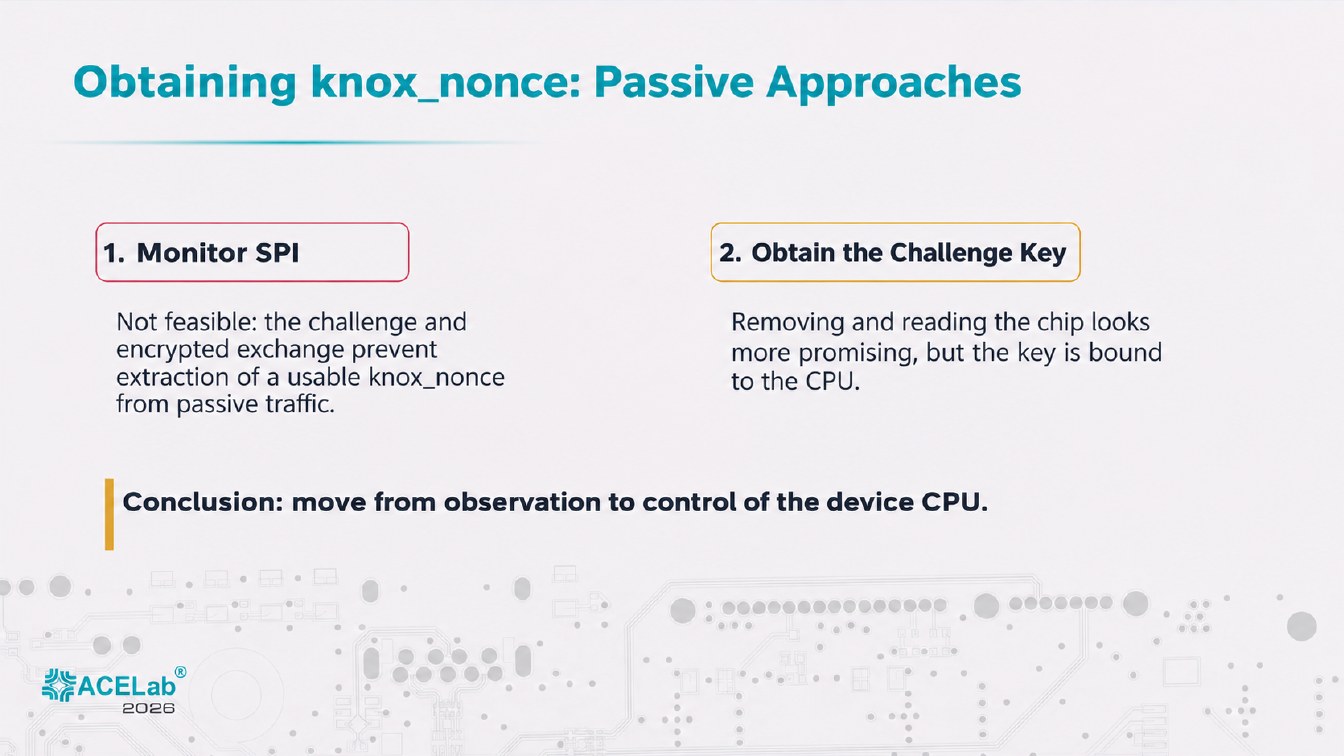
Obtaining knox_nonce: Passive Approaches
1. Monitor SPI
2. Obtain the Challenge Key
Not feasible: the challenge and encrypted exchange prevent extraction of a usable knox_nonce from passive traffic.
Removing and reading the chip looks more promising, but the key is bound to the CPU.
Conclusion: move from observation to control of the device CPU.
*ACELab®
2026
Page 10 00:25:45 Slide text
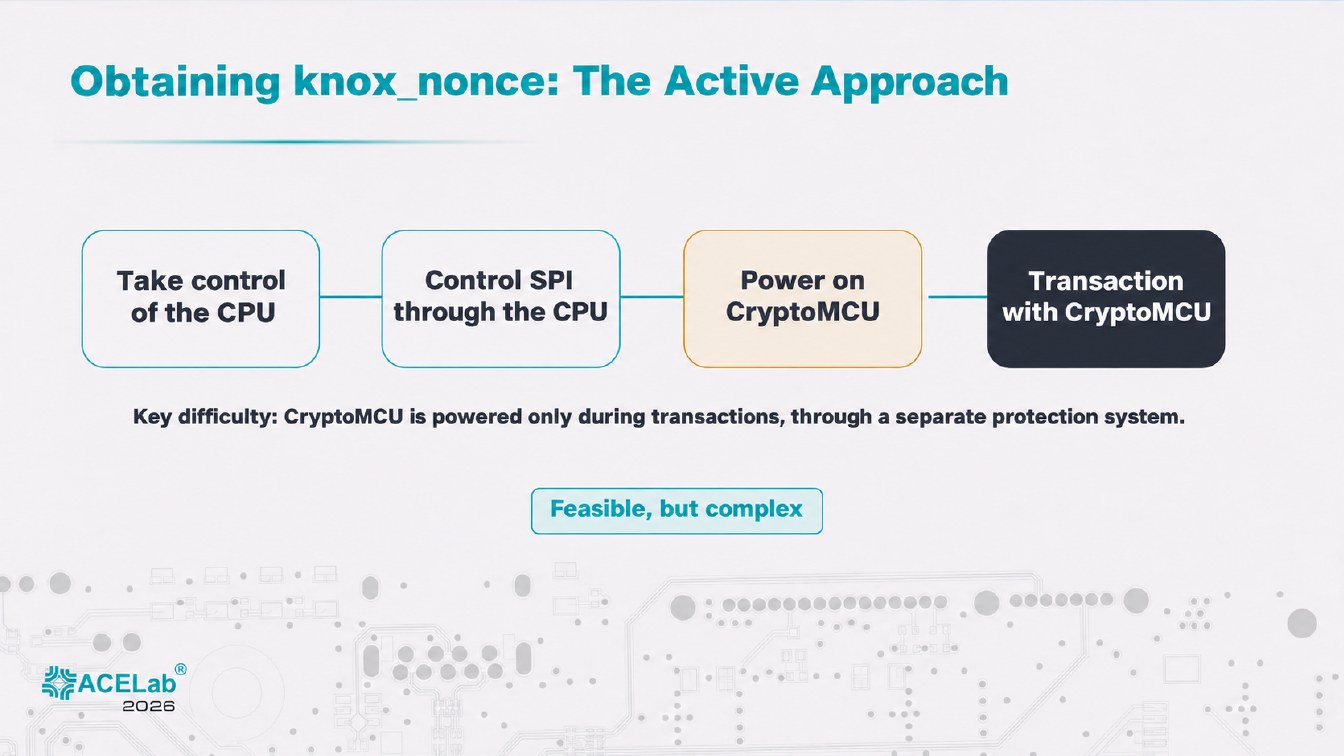
Obtaining knox_nonce: The Active Approach
Take control of the CPU
Control SPI
through the CPU
Power on
CryptoMCU
Transaction with CryptoMCU
Key difficulty: CryptoMCU is powered only during transactions, through a separate protection system.
Feasible, but complex
*FACELab®
2026
Page 11 00:26:37 Slide text
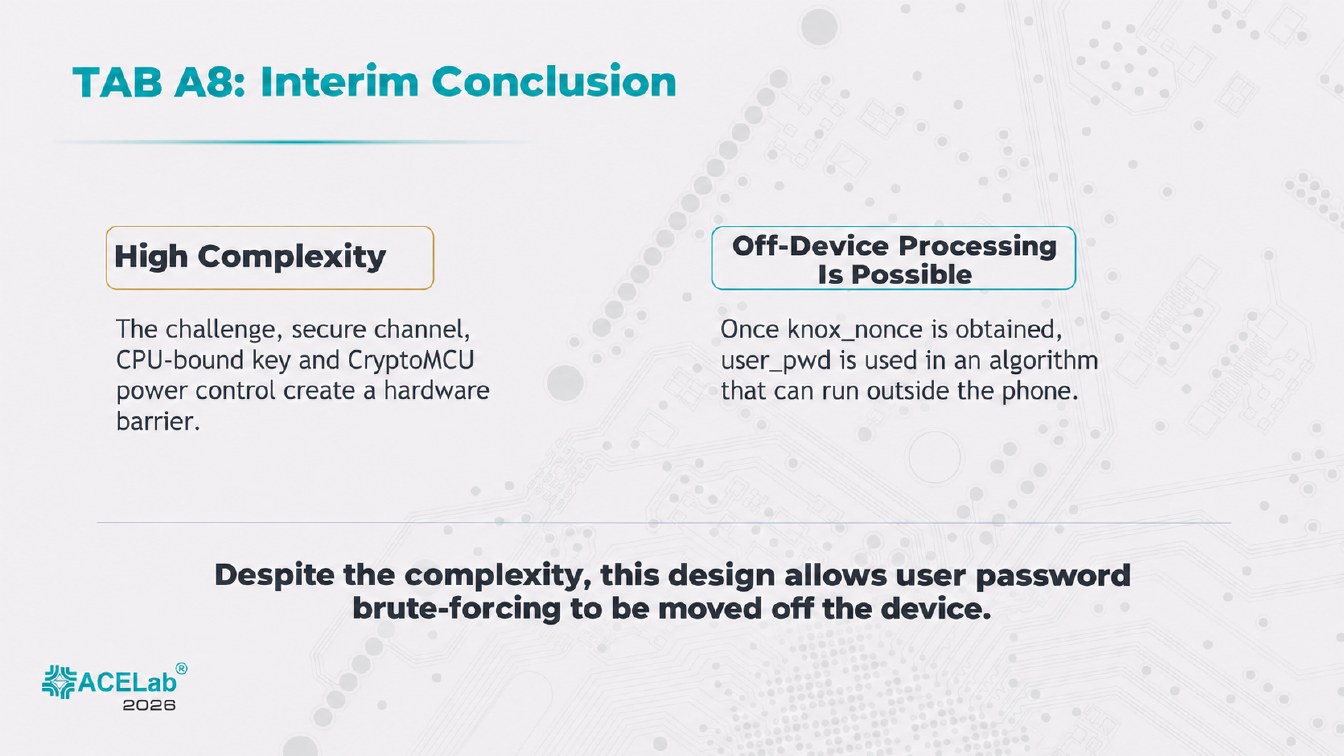
TAB A8: Interim Conclusion
High Complexity
Off-Device Processing
Is Possible
The challenge, secure channel, CPU-bound key and CryptoMCU power control create a hardware barrier.
Once knox_nonce is obtained, user_pwd is used in an algorithm that can run outside the phone.
Despite the complexity, this design allows user password
brute-forcing to be moved off the device.
LACELab®
2026
Page 12 00:27:18 Slide text
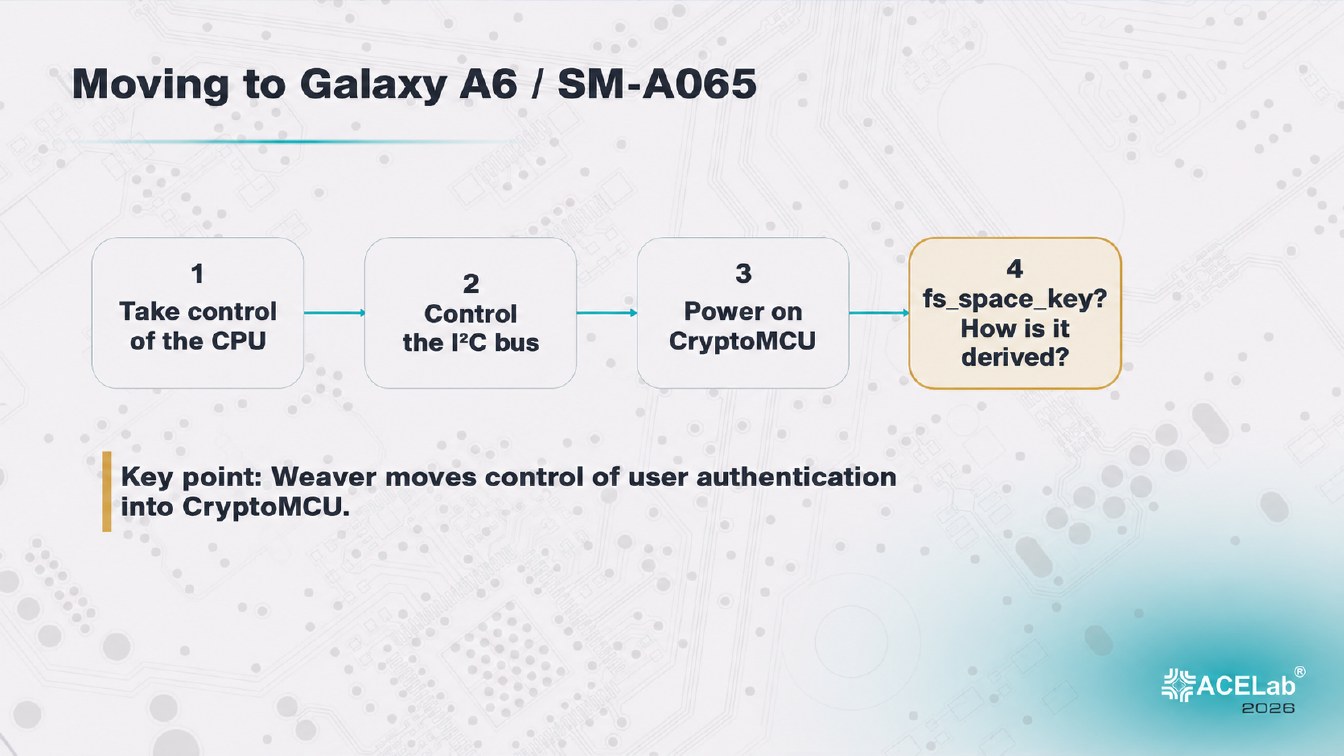
Moving to Galaxy A6 / SM-A065
1
Take control of the CPU
2
Control
the I'C bus
3
Power on
CryptoMCU
4
fs_space_key?
How is it derived?
Key point: Weaver moves control of user authentication into CryptoMCU.
*YACELab®
2026
Page 13 00:27:47 Slide text
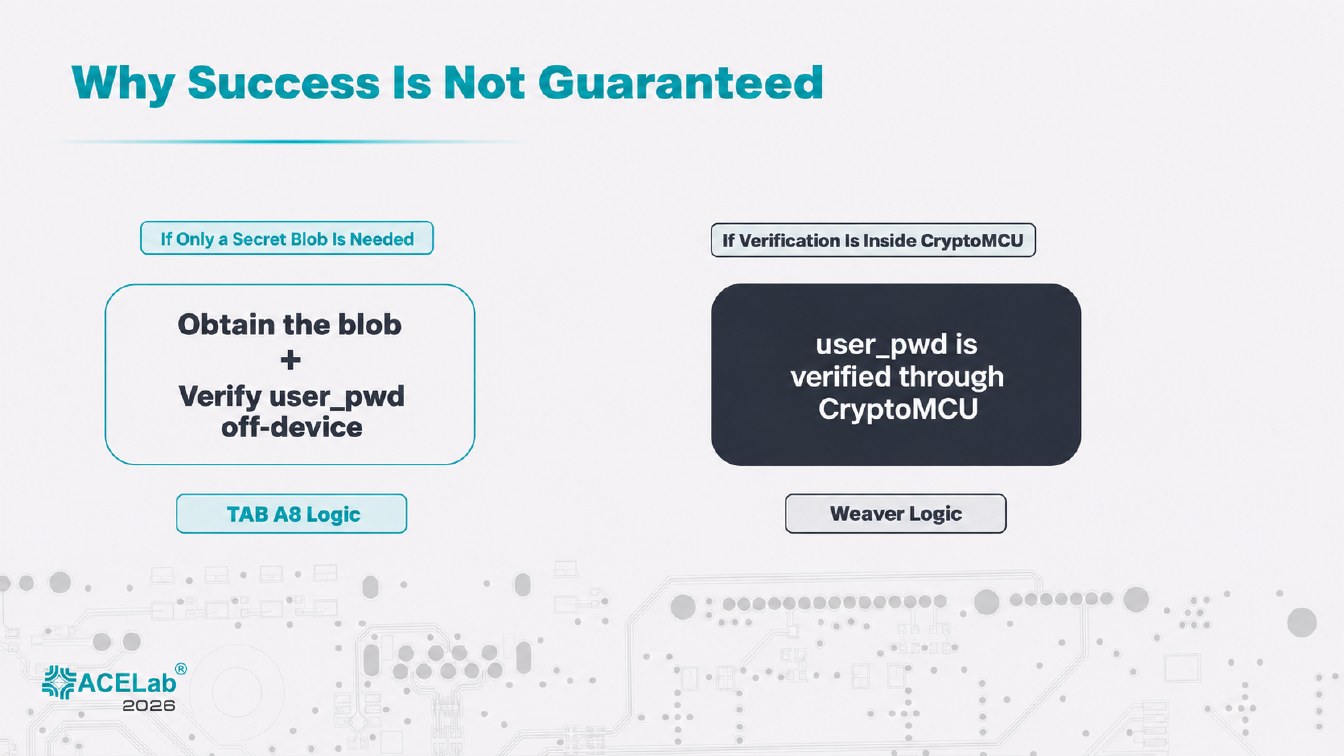
Why Success Is Not Guaranteed
If Only a Secret Blob Is Needed
If Verification Is Inside CryptoMCU
Obtain the blob
Verify user_pwd
off-device
user_pwd is verified through
CryptoMCU
TAB A8 Logic
Weaver Logic
2YACELab®
2026
Page 14 00:28:21 Slide text
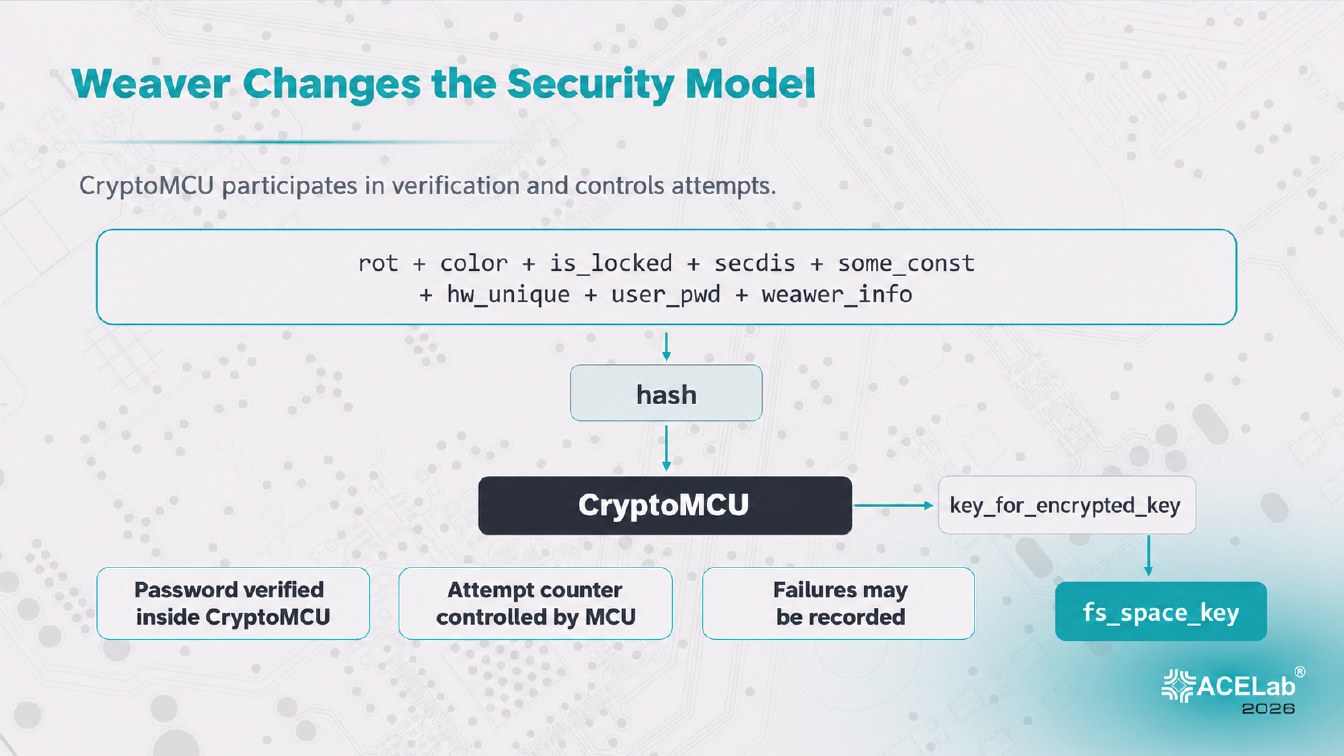
Weaver Changes the Security Model
CryptoMCU participates in verification and controls attempts.
rot + color + is_locked + secdis + some_const
+ hw_unique + user_pwd + weawer_info
hash
CryptoMCU
key_for_encrypted_key
Password verified inside CryptoMCU
Attempt counter controlled by MCU
Failures may be recorded
fs_space_key
"ACELab®
2026
Page 15 00:30:32 Slide text
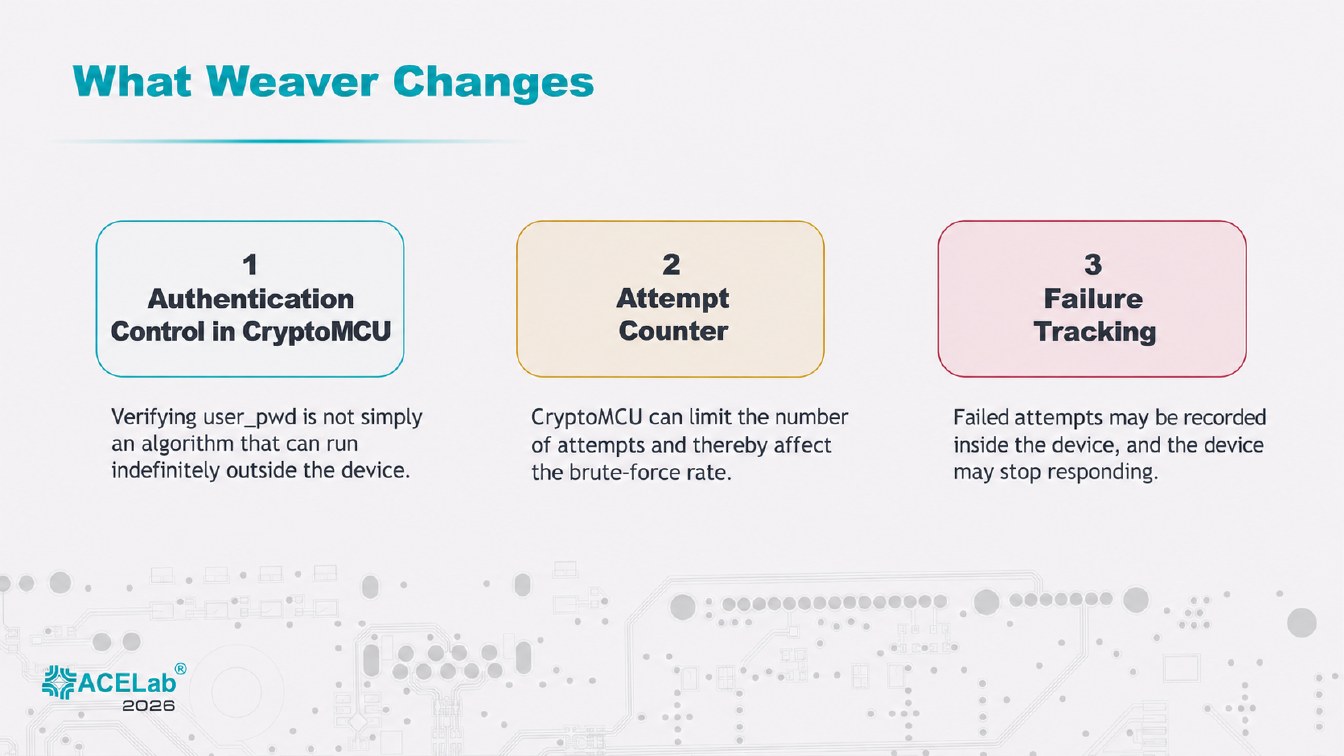
What Weaver Changes
1
Authentication
Control in CryptoMCU
2
Attempt Counter
3
Failure Tracking
Verifying user_pwd is not simply an algorithm that can run indefinitely outside the device.
CryptoMCU can limit the number of attempts and thereby affect the brute-force rate.
Failed attempts may be recorded inside the device, and the device may stop responding.
2·ACELab®
2026
Page 16 00:31:25 Slide text
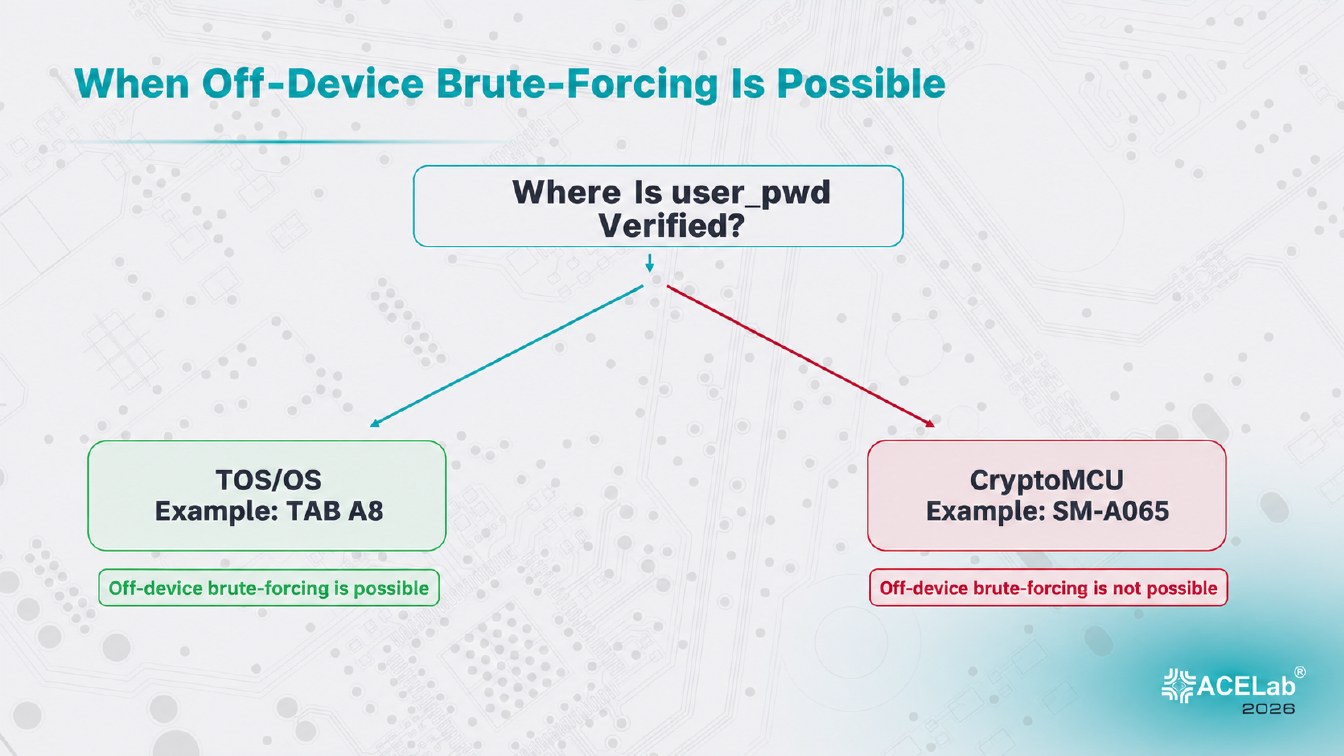
When Off-Device Brute-Forcing Is Possible
Where Is user_pwd
Verified?
TOS/OS
Example: TAB A8
CryptoMCU
Example: SM-A065
Off-device brute-forcing is possible
Off-device brute-forcing is not possible
"ACELab®
2026
Page 17 00:31:56 Slide text
Thank You
for Your Attention!
ACELab®
2026